When Should I Spay or Neuter My Puppy?

Bringing home a new puppy is an exciting milestone. From choosing the perfect name and stocking up on toys to beginning training and scheduling those first veterinary visits, there's a lot to think about during your puppy's first year.
Among all the questions new dog owners ask, one of the most common is:
"When should I spay or neuter my puppy?"
It's an important question—and one that doesn't have a one-size-fits-all answer.
If you've searched online, you've probably found conflicting information. One website recommends six months, another suggests waiting until a year, while others say it depends entirely on your dog's breed. It's understandable to feel unsure about what's best.
The truth is that every puppy is different.
At Family Pet Medical Center, we believe every recommendation should be tailored to the individual patient. Our veterinarians evaluate your puppy's breed, expected adult size, growth, lifestyle, and overall health before recommending the right time for surgery.
Our goal isn't simply to schedule a procedure—it's to help your puppy enjoy the healthiest future possible.
In this guide, we'll explain why timing matters, explore the benefits of spaying and neutering, discuss what factors veterinarians consider, and help you understand what to expect throughout the process.
Why Isn't There One "Perfect" Age?
Many owners are surprised to learn that there isn't a universal age that's right for every puppy.
Years ago, it was common to recommend surgery around six months of age for nearly every dog. While that timing may still be appropriate for many puppies, advances in veterinary medicine and ongoing research have shown that the ideal timing can vary depending on the individual dog.
A Chihuahua and a Great Dane don't mature at the same rate.
A Labrador Retriever develops differently than a Yorkshire Terrier.
Male and female dogs also have different considerations.
Because every puppy grows differently, veterinarians look at much more than just the calendar.
Instead of asking, "How old is your puppy?"
We ask questions like:
- How quickly is your puppy growing?
- What breed are they?
- How large will they be as an adult?
- Are there any underlying health concerns?
- What is their lifestyle?
- Are there medical reasons to recommend surgery sooner—or later?
Taking all of these factors into account helps us provide recommendations that are personalized rather than generalized.
Understanding Your Puppy's Growth
During the first year of life, your puppy experiences an incredible amount of physical development.
Bones grow rapidly.
Muscles strengthen.
Joints mature.
Hormones begin playing an important role in overall development.
While every puppy follows the same general stages of growth, the timeline looks very different depending on breed and expected adult size.
For example, many toy and small-breed dogs reach physical maturity much sooner than large and giant breeds.
A Great Dane may continue growing well after many smaller breeds have reached adulthood.
This is one reason why your veterinarian may recommend different surgical timing for different patients.
Rather than following advice from friends or online forums, it's always best to discuss your puppy's individual development during routine wellness visits.
What Does Spaying or Neutering Actually Mean?
Although the terms are often used together, they refer to two different procedures.
Spay
A spay is performed on female dogs and involves surgically removing the reproductive organs, preventing pregnancy and future heat cycles.
Neuter
A neuter is performed on male dogs and involves removing the testicles, preventing reproduction.
Both procedures are performed under general anesthesia and are among the most common surgeries in veterinary medicine.
For experienced veterinary teams, these procedures are performed routinely with patient safety, comfort, and pain management as top priorities.
The Health Benefits of Spaying and Neutering
Preventing unwanted litters is certainly one reason many families choose to have their puppy spayed or neutered—but it's far from the only benefit.
Depending on your dog's individual circumstances, these procedures may offer several important long-term health advantages.
For Female Dogs
Spaying eliminates the possibility of developing pyometra, a serious infection of the uterus that can become life-threatening if left untreated. It may also reduce the risk of developing mammary tumors when performed at the appropriate time.
For Male Dogs
Neutering eliminates the risk of testicular cancer and may reduce the likelihood of certain prostate-related diseases later in life.
Beyond these medical benefits, preventing unplanned litters also helps reduce pet overpopulation and supports responsible pet ownership.
Because every puppy has unique medical considerations, your veterinarian will discuss how these benefits relate to your dog's individual health.
Will It Change My Dog's Personality?
This is one of the questions we hear most often.
The answer is reassuring:
No—your puppy will still be the same dog you know and love.
If your puppy loves belly rubs today, they'll still love belly rubs after surgery.
If they're goofy, affectionate, playful, or cuddly, those personality traits don't disappear.
What may change are certain behaviors that are influenced by reproductive hormones.
For example, some dogs may be less likely to roam in search of a mate or display hormone-driven marking behaviors.
However, surgery isn't a substitute for training.
Good manners still come from consistent training, socialization, positive reinforcement, and daily enrichment.
One of the biggest misconceptions is that spaying or neutering somehow changes who a dog is.
It doesn't.
It simply removes the ability to reproduce and may reduce certain hormone-related behaviors.
Your dog's unique personality—the reason your family fell in love with them—remains exactly that: uniquely theirs.
Choosing the Right Time Is a Conversation
One of the biggest mistakes owners can make is assuming they need to decide everything on their own.
You don't.
That's exactly what your veterinarian is here for.
During your puppy's routine wellness visits, we'll monitor their growth, discuss their development, answer your questions, and help you understand the options available.
Some owners worry they'll schedule surgery too early.
Others worry they'll wait too long.
Most simply want reassurance that they're making the right decision.
Our role is to help guide you through that decision—not with a generic recommendation, but with advice based on your individual puppy.
That's one of the many reasons routine wellness visits are so valuable during the first year of life.
They're not just about vaccines and checkups.
They're opportunities to build a lifelong healthcare plan for your newest family member.
What to Expect During Your Puppy's Surgery
For many families, the thought of their puppy having surgery can feel intimidating. Even though spay and neuter procedures are among the most commonly performed surgeries in veterinary medicine, it's completely normal to feel a little anxious beforehand.
One of the best ways to ease those concerns is to understand what happens every step of the way.
Before Surgery
Before your puppy's procedure, your veterinarian will perform a thorough physical examination to ensure they are healthy enough for anesthesia. Depending on your puppy's age, health history, and individual needs, pre-anesthetic bloodwork may also be recommended to help evaluate organ function and identify any underlying concerns that aren't visible during a physical exam alone.
You'll also have the opportunity to ask any remaining questions before your puppy is admitted for surgery. Our goal is for you to feel informed and confident before leaving your pet in our care.
During Surgery
Once your puppy is safely under anesthesia, the veterinary team begins the procedure while closely monitoring vital signs throughout surgery.
Monitoring typically includes important indicators such as:
- Heart rate
- Respiratory rate
- Blood pressure
- Oxygen levels
- Body temperature
and other parameters that help ensure your puppy remains stable throughout the procedure.
Although the surgery itself is considered routine, every patient receives individualized care based on their age, size, medical history, and specific needs.
Recovery in the Hospital
After surgery, your puppy is carefully monitored as they wake from anesthesia.
Most puppies recover quietly and begin becoming more alert over the next several hours. During this time, our team continues to monitor them closely while keeping them comfortable.
Before your puppy goes home, we'll review discharge instructions, medications if prescribed, activity restrictions, and answer any questions you may have.
Preparing Your Puppy for Surgery
Preparing for surgery starts well before the appointment itself.
Once your procedure has been scheduled, our team will provide detailed instructions tailored to your puppy.
These may include guidance about:
- When to stop food before surgery
- Whether water is allowed before the procedure
- Medications your puppy should or should not receive that morning
- Arrival time
- What to bring with you
- What to expect at pickup
Following these instructions carefully helps us provide the safest possible experience for your puppy.
If you're ever unsure about something before surgery, don't hesitate to call. We'd much rather answer your questions ahead of time than have you worrying at home.
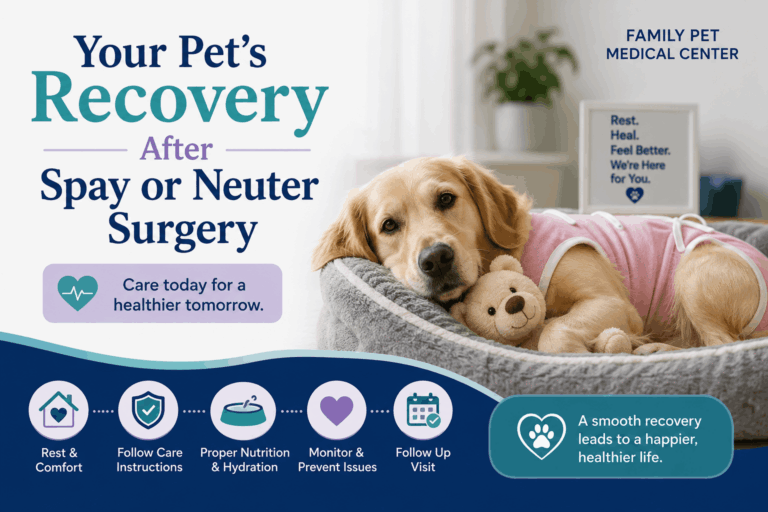
Helping Your Puppy Recover at Home
One of the things that surprises many owners is just how quickly puppies seem to bounce back.
In fact, the biggest challenge after surgery often isn't encouraging your puppy to move—it's convincing them to slow down.
Many puppies begin acting like themselves within a day or two, even though their incision is still healing.
That's why following your veterinarian's recovery instructions is so important.
The First 24 Hours
Your puppy may be:
- Sleepier than usual
- Less interested in food initially
- A little quieter than normal
These changes are common as the anesthesia continues to wear off.
Provide a quiet, comfortable place for your puppy to rest and follow your veterinarian's feeding recommendations.
The Next Two Weeks
Although your puppy may feel energetic, healing takes time.
During the recovery period, it's important to limit activities such as:
- Running
- Jumping
- Wrestling with other pets
- Fetch
- Swimming
- Long hikes
- Rough play
Restricting activity helps reduce the risk of complications and allows the incision to heal properly.
Monitoring the Incision
You'll also want to check your puppy's incision each day.
A small amount of redness immediately after surgery can be normal, but you should contact your veterinarian if you notice:
- Significant swelling
- Bleeding
- Discharge
- A foul odor
- Missing sutures
- Your puppy repeatedly licking or chewing the incision
- The incision opening
If anything doesn't look right, it's always better to ask.
Common Myths About Spaying and Neutering
There are plenty of myths surrounding these procedures, many of which have been passed from generation to generation.
Let's clear up a few of the most common misconceptions.
Myth: My dog should have one litter before being spayed.
This is one of the most common myths we hear.
There is no universal medical recommendation that every female dog should have a litter before being spayed. The appropriate timing should always be discussed with your veterinarian based on your dog's individual needs.
Myth: My puppy will become overweight.
Spaying or neutering doesn't automatically cause weight gain.
Like people, dogs gain weight when they consume more calories than they burn.
Maintaining a healthy diet, regular exercise, and routine veterinary care remain the biggest factors in helping your dog maintain a healthy body weight.
Myth: Surgery changes my dog's personality.
Your puppy will still be the same loving companion after surgery.
They'll still recognize you, enjoy their favorite toys, get excited for walks, and greet you at the door.
While some hormone-driven behaviors may change, your dog's personality does not.
Myth: Indoor dogs don't need to be spayed or neutered.
Even dogs that spend most of their time indoors may accidentally escape or encounter another dog unexpectedly.
Spaying and neutering also provide important health benefits beyond preventing pregnancy.
Why Choosing the Right Veterinary Hospital Matters
While spay and neuter procedures are common, where your puppy receives care still matters.
Every veterinary hospital has different protocols, equipment, monitoring practices, and surgical experience.
When choosing a veterinary provider, consider asking questions such as:
- Who will perform my puppy's surgery?
- How is anesthesia monitored?
- What pain management is provided?
- What happens if my puppy needs additional medical care?
- Who can I contact if I have questions after surgery?
These are all reasonable questions—and a veterinary team should be happy to answer them.
At Family Pet Medical Center, we understand that trusting someone with your puppy is a big decision.
Our goal is to provide compassionate care, clear communication, and individualized recommendations every step of the way so you can feel confident in your pet's treatment.
Investing in Your Puppy's Lifelong Health
Your puppy's first year lays the foundation for a lifetime of health.
From routine wellness visits and vaccinations to nutrition, parasite prevention, and surgery, every decision contributes to their future well-being.
Spaying or neutering isn't simply another item to check off a list—it's an opportunity to support your dog's long-term health with guidance from a veterinary team that understands their individual needs.
There's no universal timeline that's right for every puppy, which is why personalized veterinary care is so valuable.
By working together, we can determine the timing that's most appropriate for your pet and ensure they receive the highest standard of care before, during, and after surgery.
Frequently Asked Questions
When should I spay or neuter my puppy?
There isn't one age that's right for every puppy. Timing depends on breed, expected adult size, growth, lifestyle, and overall health. Your veterinarian will make a recommendation based on your individual puppy rather than a generic timeline.
Why isn't six months the right age for every dog?
Smaller breeds often reach maturity sooner than large and giant breeds. Male and female dogs also have different considerations. That's why veterinarians look at development, not just the calendar.
Will spaying or neutering change my dog's personality?
No. Your puppy will still be the same dog you know and love. Some hormone-related behaviors, such as roaming or marking, may decrease, but personality traits do not disappear.
Should my dog have one litter before being spayed?
There is no universal medical recommendation that every female dog should have a litter first. Timing should always be discussed with your veterinarian based on your dog's individual needs.
Will my puppy become overweight after surgery?
Spaying or neutering does not automatically cause weight gain. Dogs gain weight when they consume more calories than they burn. Diet, exercise, and routine veterinary care remain the biggest factors.
Do indoor dogs need to be spayed or neutered?
Yes. Even indoor dogs may accidentally escape or encounter another dog unexpectedly. These procedures also provide important health benefits beyond preventing pregnancy.
What should I expect during recovery?
Many puppies begin acting like themselves within a day or two, but healing still takes time. Limit running, jumping, swimming, and rough play, and contact your veterinarian if the incision looks abnormal.
Schedule a Consultation at Family Pet Medical Center
If you've recently welcomed a new puppy into your family and are wondering when the time is right for spay or neuter surgery, we're here to help.
At Family Pet Medical Center, our experienced veterinary team takes a personalized approach to every patient. We'll evaluate your puppy's growth, discuss your questions, explain your options, and recommend the timing that's best for their individual needs.
We're proud to care for dogs and cats throughout Fort Lauderdale and the surrounding Broward County communities, providing compassionate veterinary care in a modern, full-service hospital.
Whether you're a first-time puppy owner or have cared for dogs your entire life, we're committed to helping your newest family member get the healthiest possible start.
To schedule your puppy's consultation, call Family Pet Medical Center at 954-567-2500.